 |
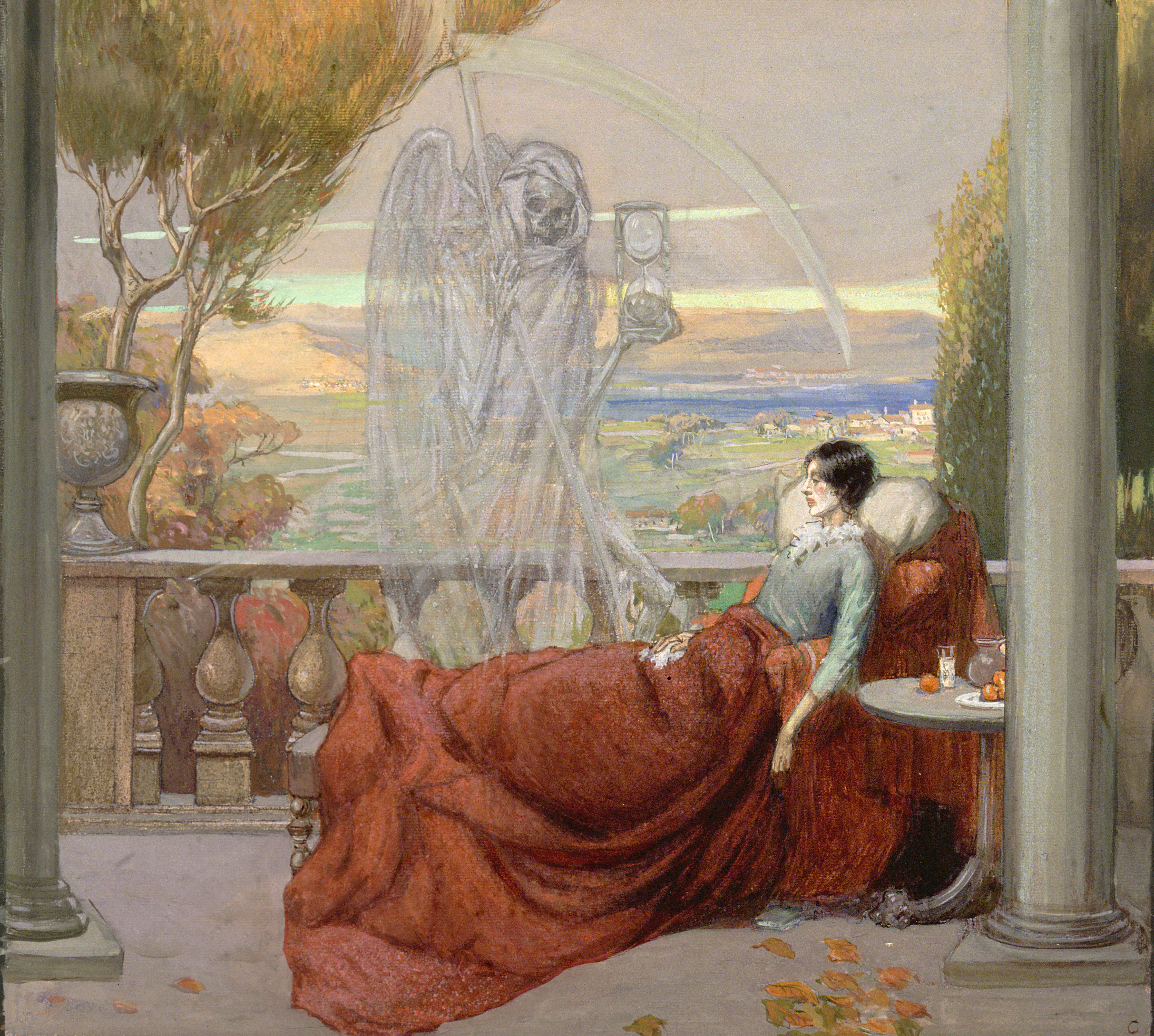
| 'A sickly female invalid sits covered up on a balcony overloo' by Richard Tennant Cooper. Credit: Wellcome Collection. |
I have always been fascinated by 19th century views on Tuberculosis. The effects it had on Victorian society is astounding. It truly was the White Plague of the 19th Century.
Oftentimes heavily romanticized, Tuberculosis or Consumption as it was known then, became associated with having a creative and a deeply spiritual mind. In the 19th century, Consumption was the most stylish and graceful way to die. Suffers of Tuberculosis were pale, thin, weak, and waif-like, as though they were slowly fading away. This was seen by many as physically attractive and desirable, conveniently forgetting that sufferers still ended up dead. Symptoms of Tuberculosis included pale skin, flushed cheeks, bright eyes, fever, loss of appetite, night sweats, and coughing up blood.
For the last several centuries, it was fashionable to have pale skin because it was a sign of wealth and beauty, and women would do anything to achieve this look; from using white powders that contained lead and arsenic to applying blood sucking leaches, the loss of blood making their skin desirably paler. As Tuberculosis made you extremely pale, this was considered aesthetically pleasing and it became fashionable to look like you were wasting away from this disease. For bright eyes, women would sometimes use eye drops that contained belladonna. As you can imagine, the ingredients in these products usually lead to permanent disfigurement and even death. Ironic how someone could end up killing themselves by trying to look as though they had a fatal disease.
Tuberculosis claimed the lives of many a famous poet, artist and writer; Including Chopin, John Keats, and Robert Louis Stevenson. Even the 19th century poet, George Gordon Byron, on his return to Athens, reportedly looked into a mirror saying, "How pale I look! I should like, I think, to die of Consumption." When his friend asked why that was, Byron replied, "Because then the woman would all say 'See that poor Byron, how interesting he looks in dying!'." Tuberculosis also created a romantic and tragic death for heroins in operas and plays and sufferers were often used as models in many famous paintings.
By the early 1880's, however, people began to realize just how dangerous the disease was. Articles began to appear, warning the public of the dangers of Consumption and urged them to take various precautionary measures. Many doctors recommended moving to a more open location, as the fresh air was a popular treatment at the time. At this point, some victims were often shunned and hidden from society. Due to the Sanitoria Movement, instead of gracefully fading at home, many were sent to Sanatoriums in an effort to naturally cure and prevent the spread of the disease. The biggest problem with this was that only the upper class could really afford to send their family members to these hospitals. The poor were left to fend for themselves or, if they were lucky they would at least be able to afford a decent doctor.
Originally these buildings were known as Sanitariums. However, the name was eventually changed in the early 1900's because, while Sanitariums were health resorts, the National Anti-Tuberculosis Association wanted to differentiate between the general health resorts and the newly emerging Tuberculosis hospitals. Though both names are sometimes used interchangeably. Unfortunately it was difficult for the poor to be able to do this because of lack of funds and poor living conditions prevented public dispensaries from duplicating the model that Sanatoriums provided. While there were many attempts at cures, nothing reliable was discovered until the 20th century.
Polite constructive criticism is welcome. I would love to read your views on 19th Century Tuberculosis! Please leave a comment below.
Reference
- The Works of George Gordon Byron: Letters, 1804-1813 by George Gordon Byron Byron
- The Sanatorium Age "Sanatorium vs. Sanitarium" http://www.lung.ca/tb/tbhistory/sanatoriums/type.html
- Spitting Blood: The History of Tuberculosis by Helen Bynum
- The White Plague: Tuberculosis, Man and Society by Rene Jules Dubos and Jean Dubos
- Fevered Lives: Tuberculosis in American Culture Since 1870 by Katherine Ott
- Harvard University Library Open Collections Program, Contagion: Historical Views on Diseases and Epidemics, Tuberculosis in Europe and North America 1800-1922 http://ocp.hul.harvard.edu/contagion/tuberculosis.html
- At the Deathbed of Consumptive Art by David M. Morens http://www.ncbi.nlm.nih.gov/pmc/articles/PMC2738548/
- Culverwell, Robert James, 1802-1852. On Consumption, Coughs, Colds, Asthma, And Other Diseases of the Chest: Their Remedial And Avertive Treatment : Addressed In Popular Language to Non-medical Readers, With Copious Observations On the Diet And Regimen Necessary for Invalids : Also, an Appendix, Containing Two Hundred Formulae of the Latest And Most Approved Remedies. New York: Published by J.S. Redfield, Clinton Hall, corner of Nassau and Beekman streets, 1849. https://hdl.handle.net/2027/uc1.31822038208294

