 |
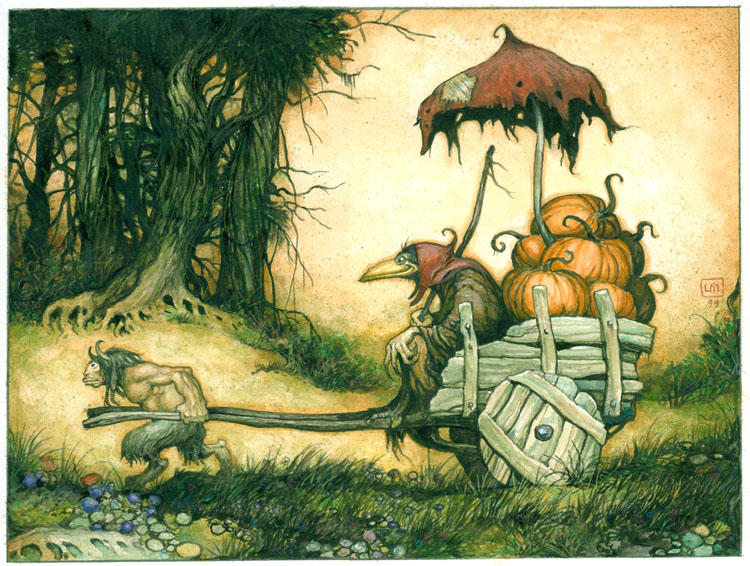
| The Pumpkin Dealer by Bridge Troll |
"By the pricking of my thumbs,
Something wicked this way comes!"
- Macbeth Act 4, Scene 1
Halloween is, hands down, my favorite holiday. And it's not just the free candy and costumes that make it so great (though that is a large part of it.) Halloween has a long and interesting history that not many people are aware of.
_(9605427).jpg "Standing Stones of Callanish by Richard Mudhar") |
| Standing Stones of Callanish by Richard Mudhar |
It all started with the ancient Celtic festival known as Samhain (Sah-win). This was a celebration of the end of the harvest season. The Celts believed that on this night, the veil between the land of the living and the spirit world was at its thinnest, and that those who had recently died were able to walk among them; whether they were friendly or not.
They were afraid that the spirits visiting them would continue to haunt them and possibly cause the deaths of others in their families. In the hopes that they could appease the visiting spirits and prevent them from sticking around, the Celts would give offerings in the form of food. Candy anyone?
They also offered up animal sacrifices, thanking mother earth for providing them with their harvest. The Druids would read the burnt entrails of the animals and use that to predict things such as who would prosper and who would die within the next year. Since the veil was so thin, Samhain was considered the best night to do this. They would also build bonfires and pray to their gods for the return of the sun. These bonfires would have likely attracted bugs which would in turn attract some of our popular Halloween symbols like bats and owls.
No story about ancient Ireland would be complete without the fairies! The Celts believed that fairies roamed the earth on Samhain with the intent to cause mischief. Much like our trick or treaters today! Though the Celts were not the only ancient people to have a hand in creating our modern, beloved Halloween.
 |
| Pomona Tapestry designed by William Morris and Edward Burne-Jones in 1885 |
As the Romans conquered more of northern Europe, the Pomona festival slowly began to merge with Samhain, creating a tradition of both honoring the dead and the harvest.
This Pagan tradition, and in fact Paganism as a whole, would soon face extreme opposition with the arrival of Christianity in the 1st Century. The Christians were highly against worshiping any other being that was not God and viewed them as demonic. They believed that the Pagans had been deceived by Satan into believing in all of these other Gods and Goddesses.
In the early 4th century, Constantine, a Roman Pagan emperor had a vision of Christ during a battle and converted to Christianity. In 325 AD, he summoned a council of Christian Bishops, which became the First Council of Nicaea, who laid out the Christian Doctrine. This inspired missionaries to go out and convert and 'save' the Pagans. Eventually, the missionaries realized that, because the Pagan tradition was so deeply rooted, converting them would be extremely difficult.
Pope Greggory I understood that Christianity was still new and that the Pagans would not just turn around and accept it at once. At the time, the general population was not interested in the Christian beliefs. Around 600 AD, he attempted to give the Pagan traditions a Christian twist in an effort to make Christianity seem more appealing.
However, by the time Pope Greggory III came along, he got fed up with trying to accommodate the Pagans. He took one of their most important holidays and claimed November 1st as All Saints Day or All Hallows Day. This day was to commemorate all of the saints who did not already have their own day. The day before was called All Hallows Evening.
This is where the name Halloween comes from. All Hallows Evening became All Hallows Eve, the word eventually slurred to become Hallowe'en. There were many pagans who continued to practice their traditions, but under the name Hallowe'en instead.
Realizing this, the church took it one notch higher and declared November 2nd as All Souls Day. This day was to remember everyone who had died in the last year, whether they were a saint or not. This practice was directly taken from Samhain, but it was not enough to convince the Pagans to give up their ancient traditions.
Another practice that bothered the Church was what the Old English called Wise Ones or Wiccans. To the Christians, they were known as Witches and represented the worst parts of Paganism. These were usually women who, they believed, were unruly and violent and who delved into the darker aspects of Halloween. Witches were considered the Devil's accomplices and often depicted as ugly, deformed, violent hags. Even animals associated with witches became a demonic symbol. Specifically, the black cat was believed to be a witch in animal form.
 |
| Burning of three witches in Baden, Switzerland (1585), by Johann Jakob Wick |
In 1486, Pope Innocent VIII issued a papal bull called Summis desiderantes affectibus that claimed a direct link between Witchcraft and the Devil and gave his permission to practice witch hunting. It was a response to the request of the Inquisitor Heinrich Kramer, asking for the authority to prosecute witchcraft in Germany.
Halloween is seen in different cultures all across the world. In Mexico, the Day of the Dead is an ancient festival on All Souls Day that celebrates the dead instead of deaminizing it. Families would have picnics at the grave sites of loved ones and build alters to fondly remember them.
Martin Luther posted his Thesis on Halloween in 1517. He launched the protestant reformation and rejected All Saints Day among other things. Technically, this rejected All Hallows Eve as well; however the Protestants used the day to exploit their fight with the Catholics. Guy Fawkes was arrested on November 5 for attempting to blow up the House of Lords, which was heavily dominated by Protestants. This day became a popular English holiday but is often merged with Halloween because the dates are so close.
 |
| "The Trial of George Jacobs, August 5, 1692" by Thompkins H. Matteson |
1692 brought about a bloody climax in the form of the Salem Witch Trials. Dozens of people were falsely accused of witchcraft. 19 people were hung (5 of which were on my birthday!) and one man named Giles Corey was pressed to death with rocks because he refused to confess. Many others died in prison.
Thankfully it was not the same all over America. All of the colonies believed in witchcraft and the occult but not all of them took it the same way as the Puritans. In Virginia and other southern colonies there was a heavy Catholic and Anglican population and Halloween thrived. Divination games were extremely popular, especially if it predicted ones romantic future. They held parties that involved bobbing for apples, carved pumpkins and ghost stories, all of which are still present today.
 |
| Vintage Halloween Postcard |
the arrival of Irish immigrants. Those customs that didn't quite work out were adapted to fit their new home. Carving turnips like they did in Ireland was much harder than the American pumpkin and is just one example of how Victorian America attempted to tame Halloween. By the end of the 19th century, the witchcraft and evil that had been previously associated with the holiday were almost gone and children began to take over.
When WWI broke out, America began to grow up. People were no longer interested in seeing recipes and crafts in newspapers. Instead they became more educational, and the people became more practical. Adults stopped participating in Halloween parties and sent their children out to have fun instead. The problem with letting children roam the streets was that there was a reappearance of mischief and harmful pranks. Communities tried many things in order to reign the children in, including the first ever Halloween parade.
WWII dampened America's festive mood. Resources were scarce and kids were more focused on collecting scrap metal for the war than dressing up and begging for sweets. Halloween activities in most cities were canceled. However, once the war was over, Halloween came back with a vengeance. Communities still focused on keeping it safe for children. There were organized Halloween costume parties and trick or treating to help keep mischief at bay.
 |
| Trick 'r Treat by Michael Dougherty, 2007 |
Popular culture did not help. Movies, like some of my own, personal favorites, Trick r Treat, the Addams Family and Abbott and Costello Meet Frankenstein, used these rumors and fears to their advantage. The Mainstream was filled with everything from psychopathic murderers to comical monsters and the holiday once again showed it's darker side.
 |
| Intro from Abbott and Costello Meet Frankenstein |
Today, Halloween is now a multi billion dollar industry. There are movies, TV shows, songs, dolls, toys, and games that all have roots in Halloween. Most people now, instead of making costumes, will spend anywhere from $30 to several hundred on costumes and props.
Essentially, Halloween has become a mix of terror and mockery of everything that frightens us.
And it is still the best holiday out of the entire year!
Happy Halloween!
References
- Swimmer, Jeff. "The Haunted History of Halloween." The Haunted History of Halloween. The History Channel. N.d. Television.
- University of Pennsylvania. Dept. of History: Translations and Reprints from the Original Sources of European history, published for the Dept. of History of the University of Pennsylvania., Philadelphia, University of Pennsylvania Press [1897?-1907?]. Vol III:4, pp, 7-10 (Papal Bull), 6-7 (Nider), 10-13 (Hammer)
- "List of People in the Salem Witch Trials." Wikipedia. Wikimedia Foundation, n.d. Web. 14 June 2015.
- "Bewitchment in Salem: The Real Story." YouTube. YouTube, 19 Nov. 2014. Web. 14 June 2015.
- Cawthorne, Nigel. Witch Hunt: History of a Persecution. Edison, NJ: Chartwell, 2004. Print.